
Carrick-a-Rede Rope Bridge: Tickets, Walk & Visitor Guide
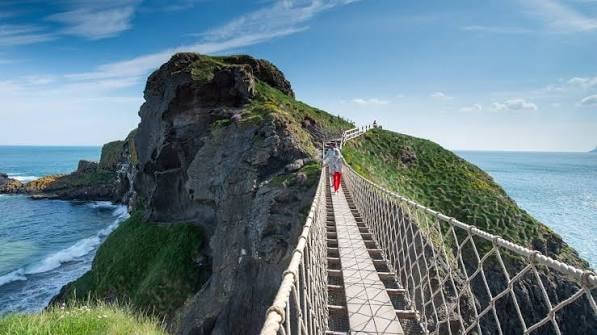
Carrick-a-Rede Rope Bridge
Hanging almost 30 metres above the Atlantic on Northern Ireland's Causeway Coast, Carrick-a-Rede is one of Ireland's most dramatic crossings — built by salmon fishermen in 1755 and still swaying gently in the sea breeze today.
About
Carrick-a-Rede is located near Ballintoy in County Antrim, along the Causeway Coastal Route — roughly 5 miles west of Ballycastle and 7 miles east of Bushmills and the Giant's Causeway area. The official address is 119a Whitepark Road, Ballintoy, BT54 6LS. That location makes it incredibly easy to combine with other major Causeway Coast attractions, though both Carrick-a-Rede and the Giant's Causeway deserve proper time rather than a rushed 45-minute visit each.
If you want to cross the rope bridge, advance booking is essential. The National Trust currently states that visitors should pre-book before travelling, including National Trust members and Neighbour Pass holders. Popular time slots can fill, so don't drive along the Causeway Coast assuming you'll simply buy a bridge ticket when you arrive. Current 2026 National Trust peak crossing prices start from £16 for adults (18+), £8 for children (5–17), free for under-fives, £40 for a family of two adults and up to three children, and £24 for a one-adult family. These prices include the Visitor Experience and onsite parking.
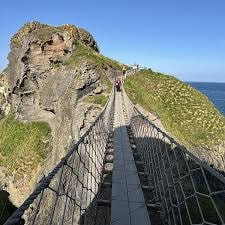
The bridge crosses a roughly 20-metre gap between the mainland cliffs and Carrick-a-Rede Island, hanging around 30 metres — almost 100 feet — above the sea. Modern safety standards make today's bridge considerably more reassuring than the fishermen's original version. But it still moves. The National Trust notes that visitors are sometimes surprised to discover the bridge sways slightly while crossing. That's normal. Possibly not comforting. But normal. The name Carrick-a-Rede comes from the Gaelic Carraig-a-Rade, meaning approximately 'The Rock in the Road' — referring not to a road for people, but to the migration route taken by Atlantic salmon as they moved along the coastline searching for their home rivers.
The first rope bridge was erected in 1755, allowing salmon fishermen to reach Carrick-a-Rede Island without relying entirely on boats. Atlantic salmon had been fished around Carrick-a-Rede and nearby Larrybane since at least 1620. Generations of local families operated salmon nets from the island, crossing the bridge carrying ropes, nets, equipment and their catch. The island also contains a historic fisherman's cottage described by the National Trust as more than 400 years old, used for shelter and equipment storage. It opens on selected weekends. Even when closed, it tells the story of Carrick-a-Rede as a working fishing site rather than merely a tourist attraction.
The coastline around Carrick-a-Rede is excellent for wildlife. The National Trust highlights marine animals including dolphins, porpoises and basking sharks. Birdlife includes guillemots, razorbills, kittiwakes and fulmars. Bring binoculars if you have them, particularly during spring and summer. Once across the bridge, Carrick-a-Rede Island gives you spectacular views back towards the mainland cliffs and along the Causeway Coast — on clear days you may see Rathlin Island and even the Scottish islands beyond. Don't simply cross the bridge, touch the island and immediately turn around. The view is half the experience.
The bridge can close temporarily during high winds or severe weather. If you've booked directly through the official National Trust website and the bridge is closed because of wind, the National Trust currently says you'll receive a full refund. The coastal walk remains worthwhile even if the bridge is closed — the cliff scenery is spectacular from the mainland. The National Trust grades the coastal walk as Moderate, with grass, gravel, uneven surfaces, slopes, cliffside steps and a steep metal staircase immediately before the bridge. The walk from the car park to the bridge is approximately 1km each way, with the full official coastal route around 1.6km taking roughly one hour. Most visitors spend around 1½–2 hours at Carrick-a-Rede overall. The Weighbridge Tearoom provides tea, coffee, scones, sandwiches and ice cream — our preferred order is bridge first, scone afterwards.
Best Time to Visit
Morning visits are generally quieter with easier parking and more time left for the rest of the Causeway Coast. Autumn is particularly recommended by the National Trust for dramatic coastal views, seabird activity and fewer peak-season crowds. Summer is the busiest period — book early time slots. The bridge closes during high winds, so check conditions on the morning of your visit even if you've pre-booked. The coastline is accessible dawn to dusk; bridge-crossing hours are shorter (currently 9am–4:30pm in October 2026), so don't arrive near sunset assuming you're crossing.
Getting There
Carrick-a-Rede Rope Bridge is at 119a Whitepark Road, Ballintoy, County Antrim, BT54 6LS — roughly 5 miles west of Ballycastle and 7 miles east of Bushmills. Onsite parking is included with rope-bridge Visitor Experience tickets, with overflow parking at Larrybane Quarry when required. Pre-booking is essential for bridge crossings. The site combines easily with the Giant's Causeway (7 miles), Ballintoy Harbour, Bushmills Distillery and Dunluce Castle along the Causeway Coastal Route.
Highlights
Quick Facts
County
County Antrim
Region
Northern Ireland
Category
Coastal


Keep exploring