
Diamond Hill — Travel Through Ireland
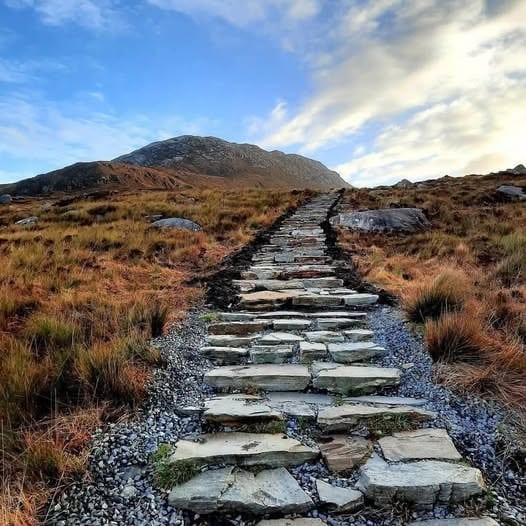
Diamond Hill
The finest short mountain walk in the west of Ireland.
About
Diamond Hill is the centrepiece of Connemara National Park and one of the most popular short mountain walks in Ireland — and for good reason. Rising to 442 metres above the village of Letterfrack on the edge of the Twelve Bens, it offers a genuinely rewarding summit experience without the technical difficulty or time commitment of the higher peaks. The well-maintained looped trail from the National Park Visitor Centre takes most walkers between two and three hours, and the views from the top are among the finest in Connemara.
The mountain takes its name from the way its quartzite summit catches the light — on a bright day, the pale rock glitters like a diamond against the dark bog below. The trail climbs steadily through open moorland, with the Twelve Bens rising to the south and the Atlantic coast opening up to the west as you gain height. The upper section involves some scrambling over quartzite rock, but the path is well-marked and the footing is generally good. The summit ridge is narrow and exposed, and the views in every direction are extraordinary.
From the summit on a clear day, the panorama takes in the full sweep of Connemara — the dark peat bogs and silver lakes of the lowlands, the jagged profile of the Twelve Bens to the south, the long Atlantic coastline stretching towards Clifden to the west, and the mountains of Mayo across Killary Harbour to the north. Directly below, tucked into its wooded valley on the shores of Pollacappul Lake, you can pick out Kylemore Abbey — one of the most satisfying views in the whole walk, and a reminder of how close the two are.
The Connemara National Park covers 2,957 hectares of bog, heath, grassland, and woodland, and Diamond Hill is its most prominent feature. The park is home to a herd of Connemara ponies — Ireland's only native horse breed — which graze freely on the lower slopes and are often visible from the trail. Red deer, introduced to the park in the 1980s, are also present, though more elusive. The lower slopes of the trail pass through areas of blanket bog that are among the finest examples in Ireland, and the park's interpretive centre provides excellent context for the landscape.
Letterfrack village, at the foot of Diamond Hill, is a small but well-equipped base for exploring this part of Connemara. The Connemara National Park Visitor Centre has good exhibitions on the park's ecology and history, and the café is a welcome stop after the descent. Kylemore Abbey is just 10 minutes' drive east along the N59, making the combination of Diamond Hill in the morning and Kylemore in the afternoon one of the finest full days in the west of Ireland. The drive between the two, through the wooded valley with the Twelve Bens reflected in the lakes, is itself one of the great short drives in Connemara. If you're spending the night in Galway city after your day in Connemara, Kai on Sea Road is one of the finest restaurants in the west of Ireland and well worth booking ahead for dinner.
Best Time to Visit
Diamond Hill can be walked year-round, but the best conditions are from April to October when the days are longer and the weather more settled. June and July offer the longest daylight hours and the best chance of clear summit views. The mountain is popular in July and August — start early to have the upper trail to yourself. Autumn brings beautiful colours to the lower slopes and the bog. Winter walks are possible on fine days but the upper section can be icy and the short daylight hours limit your time. The Connemara National Park Visitor Centre is open from March to November.
Getting There
Diamond Hill is located in Connemara National Park, accessed from the village of Letterfrack on the N59 between Clifden and Leenane. The National Park Visitor Centre car park is the starting point for the trail. From Clifden it's about 20 minutes; from Leenane about 15 minutes; from Galway City about 1 hour 20 minutes. There is a car park at the Visitor Centre (fee applies in summer). Kylemore Abbey is just 10 minutes east along the N59. Public transport to Letterfrack is limited — a car gives the most flexibility.
Insider Tips
Take the looped trail anticlockwise — the lower loop first, then the upper summit trail — so you gain height gradually and arrive at the summit with the best views ahead of you rather than behind.
Bring waterproofs and layers regardless of the forecast — Connemara weather changes quickly and the summit is exposed. Good walking boots are essential; the upper section involves scrambling over wet quartzite.
Start early in summer to avoid the crowds on the upper trail — the path narrows significantly above the lower loop and can feel congested by mid-morning in July and August.
Look out for the Connemara ponies on the lower slopes — they graze freely in the park and are often close to the trail. Don't feed them, but they're generally calm and make for excellent photographs.
Combine Diamond Hill with a visit to Kylemore Abbey — just 10 minutes east along the N59. Climbing Diamond Hill in the morning and visiting Kylemore in the afternoon makes a perfect full day in this part of Connemara.
If you're heading back to Galway city for the night, Kai on Sea Road is one of the finest restaurants in the west of Ireland — book ahead, it fills up quickly.
Highlights
Quick Facts
County
County Galway
Region
West
Category
Mountains
More to Explore


Keep exploring