
Stairway to Heaven Fermanagh: Cuilcagh Walk & Parking Guide
Stairway to Heaven
The iconic Cuilcagh Boardwalk Trail — a 11km mountain walk across blanket bog to the famous wooden staircase and sweeping views over County Fermanagh.
About
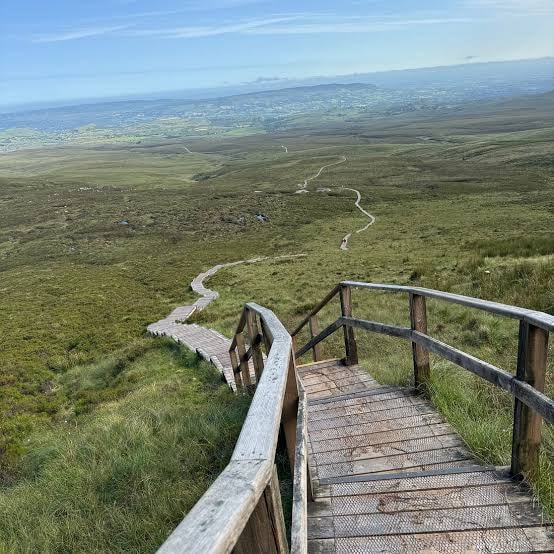
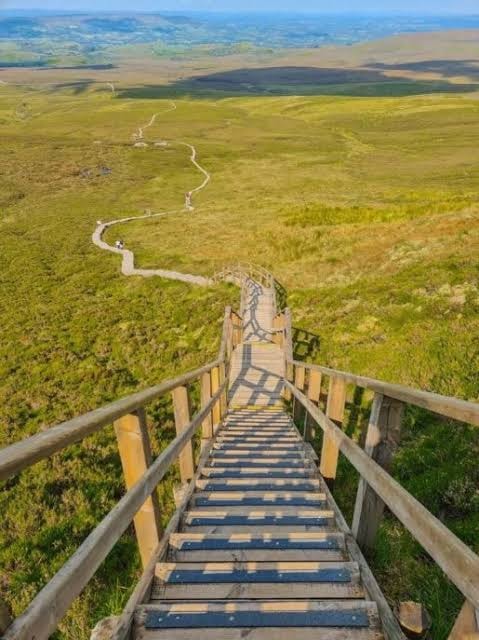
Rising through one of the largest areas of blanket bog in Northern Ireland, the Cuilcagh Boardwalk Trail has become one of the most recognisable walks on the island of Ireland. Most people know it by another name — the Stairway to Heaven. A long wooden boardwalk snakes across the bog before suddenly climbing towards the dramatic flat-topped slopes of Cuilcagh Mountain. Then come the stairs. Lots of them. The final section climbs steeply between rocks before reaching a viewing platform overlooking the countryside of County Fermanagh. It's the photograph from those stairs that transformed Cuilcagh into a social-media sensation. But there's much more to this walk than an Instagram photograph.
The boardwalk was originally constructed to protect the incredibly fragile blanket bog beneath your feet, and the route passes through a landscape containing limestone grassland, peatland, wildlife, old farm remains and thousands of years of natural history. The walk is around 11–13km return depending on your exact starting point, generally takes around 3 hours, and is officially graded difficult. So despite the beautifully constructed boardwalk, don't mistake this for an easy stroll. The Stairway to Heaven is located on Cuilcagh Mountain near Florencecourt in County Fermanagh, approximately 20km southwest of Enniskillen and close to the border with County Cavan. The main entrance is on Marlbank Road, a short distance beyond the Marble Arch Caves Visitor Centre.
The opening section of the walk follows a gravel farm track through an unusual limestone landscape sometimes known locally as The Fertile Rock because of its species-rich grasslands. Look carefully and you can see dry-stone walls, abandoned cottages and old potato ridges known as lazy beds — a landscape shaped by generations of farming. Gradually the scenery changes as the limestone farmland gives way to open blanket bog, and ahead of you Cuilcagh's unmistakable flat-topped ridge begins to dominate the horizon. The boardwalk wasn't built simply to make the walk easier — it was created to protect the blanket bog. Peatland can be incredibly fragile, and repeated footsteps damage vegetation, expose peat and create erosion channels. Stay on the boardwalk at all times.
Visit during late spring and early summer and you may see bog cotton spreading across the landscape — its white fluffy heads can make sections of the bog look as though they've been dusted with snow. Later in summer, purple moor grass changes the colour of the landscape again. The area is also home to red grouse, and the mountain and bog form part of a highly protected environment. Then you reach the bit you've seen in the photographs. The boardwalk starts climbing, and climbing, before eventually turning into a steep wooden staircase weaving between boulders towards the mountain plateau. Take your time — there's no benefit in sprinting up the stairs. Stop when you need to, and turn around occasionally. The views become increasingly impressive as you gain height.
At the top of the stairway you'll reach the Cuilcagh Boardwalk viewing platform — the destination for the standard visitor walk. From here you've got huge views across the surrounding Fermanagh landscape. On a clear day, the countryside seems to stretch forever. One important distinction: the famous boardwalk takes visitors to the viewing platform near the edge of the mountain plateau, not to the actual summit of Cuilcagh Mountain. Cuilcagh's summit stands at approximately 665 metres and contains an ancient Bronze Age cairn, but the Geopark currently asks visitors not to continue beyond the Boardwalk viewing platform. The habitat beyond the platform is extremely fragile — when you reach the end of the boardwalk, that's where to turn around.
Cuilcagh reaches approximately 665 metres — 2,188 feet — above sea level. It's the highest point in both County Fermanagh and County Cavan, and its distinctive flat summit makes it easy to recognise from a considerable distance. The mountain forms the dramatic centrepiece of the surrounding landscape and sits within the Cuilcagh Lakelands UNESCO Global Geopark, which extends across parts of Counties Fermanagh and Cavan and contains limestone caves, mountains, forests, lakes, bogland and archaeological sites. Before the boardwalk was built, increasing numbers of walkers were creating severe erosion across the blanket bog. The wooden structure was installed as a conservation measure — and ironically, the boardwalk itself then became famous, with visitor numbers growing from around 3,000 walkers a year to roughly 60,000 in 2015 as images spread online.
For parking, you've essentially got two options. The privately operated car park is the closest to the start of the trail, currently costing £6 per car, with pre-booking strongly encouraged during busy periods — a booking provides a three-hour parking slot and the car park operates from around 7am–7pm. Alternatively, Killykeeghan National Nature Reserve car park is located approximately 1km farther along the road and provides free parking, toilets, picnic facilities and interpretation. There is no separate walking admission charge for the Boardwalk itself — the £6 relates only to the closest private car park. The best nearby toilet facilities are at Killykeeghan Nature Reserve and Marble Arch Caves Visitor Centre during its operating hours.
The obvious attraction to combine with Cuilcagh is Marble Arch Caves, practically next door. The guided underground experience takes visitors through an extraordinary limestone cave system beneath the Fermanagh landscape — start above ground at Cuilcagh, then go underground at Marble Arch. One landscape, two completely different experiences. Nearby Florence Court is another excellent addition — the National Trust property includes an 18th-century mansion, gardens, woodland trails and extensive estate grounds beneath Cuilcagh Mountain. Enniskillen makes the obvious base for exploring Fermanagh, sitting between Upper and Lower Lough Erne with plenty of accommodation, restaurants and pubs. And if you've come to Fermanagh for Cuilcagh, don't leave without seeing Lough Erne — the waterways, islands, castles and ancient monastic sites are what make this county particularly special.
Best Time to Visit
A dry, clear weekday morning is ideal if possible. Summer provides long daylight hours but is also the busiest period. Spring can be beautiful when bog cotton begins appearing across the bog. Early autumn is another great option, with changing colours across the landscape. Whenever you visit, start earlier rather than later — you'll get quieter trails, more parking availability and a more relaxed experience. Winter walking is possible when the trail is officially open and conditions are suitable, but ice, snow, strong winds and short daylight hours can completely transform the mountain. Cuilcagh has been temporarily closed during severe winter conditions — always check official Cuilcagh Lakelands updates before travelling.
Getting There
The Cuilcagh Boardwalk Trail (Stairway to Heaven) is located on Marlbank Road, near Florencecourt, County Fermanagh, approximately 20km southwest of Enniskillen. The main entrance is a short distance beyond the Marble Arch Caves Visitor Centre. The privately operated car park closest to the trailhead currently charges £6 per car — pre-booking is strongly recommended at weekends and during summer. Free parking with toilets and picnic facilities is available at Killykeeghan National Nature Reserve approximately 1km farther along the road. Enniskillen is the nearest large town, roughly a 30-minute drive away.
Insider Tips
Book the closest car park before you travel if visiting at a busy time — it's currently only £6 per car, and having a guaranteed space near the trailhead is worth it when you've already got several hours of walking ahead of you. The car park operates from around 7am–7pm with the final standard booking slot at 4pm. Alternatively, free parking is available at Killykeeghan Nature Reserve approximately 1km farther along the road.
Wear proper footwear and bring waterproofs — this is a mountain walk, not a promenade. Bring walking boots or sturdy walking shoes, a waterproof jacket, a warm layer, water, snacks, hat and gloves outside summer, and sun protection in brighter weather. Conditions can change rapidly on Cuilcagh even when Enniskillen is enjoying beautiful weather. The trail is officially graded difficult, approximately 11–13km return, and takes around 3 hours — allow 3–4 hours comfortably.
The official visitor route ends at the viewing platform — do not continue beyond it towards the summit. The habitat beyond the platform is extremely fragile, and the Geopark asks visitors to turn around at the boardwalk's end. Also stay on the boardwalk at all times — don't climb off for a better photograph or walk across the surrounding peatland. Dogs are not permitted on the trail, and the route is not wheelchair accessible or suitable for standard buggies.
Combine Cuilcagh with Marble Arch Caves for one of Fermanagh's best days out — start above ground on the famous staircase, then go underground through the extraordinary limestone cave system. One landscape, two completely different experiences. If you've got more time, Florence Court and the Fermanagh Lakelands around Lough Erne are both worth adding to a wider Fermanagh trip.
Highlights
Quick Facts
County
County Fermanagh
Region
North
Category
Mountains


Keep exploring