
Slea Head Drive: Route, Stops & Complete Visitor Guide
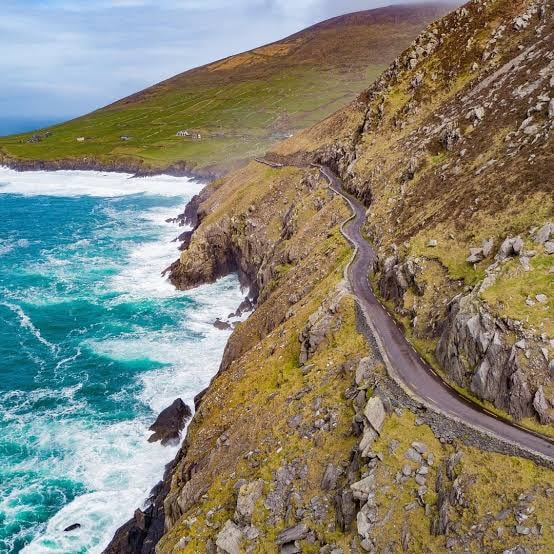
Slea Head Drive
A spectacular 47–48km coastal loop from Dingle along the R559, passing ancient forts, beehive huts, Coumeenoole Beach, Dunquin Pier and the Blasket Islands — one of the finest scenic drives in Ireland.
About
Slea Head Drive begins and ends in Dingle town, following the R559 west and clockwise around the Kingstown Peninsula. The route is approximately 47–48km long and forms part of the Wild Atlantic Way. You could physically drive it in around an hour. But that is not how to do it. The Dingle Peninsula Tourism Alliance recommends allowing at least half a day, and we agree — five to six hours is better if you want to stop properly. Leave Dingle and head first towards Ventry, then continue clockwise around the peninsula. Follow road signs rather than sat-nav, which may try to send you along An Clasach between Ard a'Bhóthair and Dunquin — a road designated Local Access Only. Stay on the signed Slea Head route.
The first main stop heading west is Ventry — Ceann Trá. The village sits beside a long curved beach overlooking Ventry Harbour. Ventry Beach is around 3km long, has a sheltered bay and seasonal lifeguard cover, and is currently promoted locally as a Blue Flag beach. It is one of the better swimming stops on the route and is considerably calmer than the more dramatic beaches farther around the peninsula. Continuing west, the road passes the area around Dún Beag Fort — an ancient stone fort sitting dramatically close to the cliffs — and several groups of clocháns, the dry-stone beehive huts built without mortar that are among the most distinctive archaeological features of the Dingle Peninsula.
Eventually you reach Slea Head itself — Ceann Sléibhe — marked by a roadside crucifixion sculpture. From here you get enormous views across the Atlantic, the Blasket Islands, South Kerry and the surrounding cliffs. The Blasket Islands dominate the sea views around the western side of the peninsula. The largest is Great Blasket — An Blascaod Mór — home to a remarkable Irish-speaking community whose writers produced some of the most important accounts of traditional island life in Ireland. From Slea Head and Dunquin they look incredibly close. One of the most dramatic stops is Coumeenoole Beach, which sits beneath steep cliffs with the Blasket Islands offshore. It is beautiful and wild — but the Dingle Peninsula's official beach guide warns that strong currents make Coumeenoole unsafe for swimming. Use it for walking, photography and watching waves. Coumeenoole was also used as a filming location for the 1970 film Ryan's Daughter.
Next comes Dunquin Pier — Cé Dhún Chaoin — one of the most photographed locations in Kerry. The famous narrow path zigzags dramatically down the cliff towards the small pier, and from above you get the winding path, rocky sea stacks, Blasket Sound and Great Blasket Island in the distance. Dunquin Pier is also one of the departure points for seasonal ferries to Great Blasket Island, which operate weather-dependently during the main visitor period. Nearby, the Blasket Centre — Ionad an Bhlascaoid — is one of the best indoor stops on the drive. This excellent heritage centre tells the story of the Blasket islanders, their language, literature and eventual evacuation in 1953. The centre is open daily from 10am to 6pm until 8 November 2026, with admission at €5 adult, €13 family and free for under-12s.
Continuing clockwise, the route passes through Ballyferriter — Baile an Fheirtéaraigh — one of the main villages in the Corca Dhuibhne Gaeltacht, where Irish remains an important community language. It is a good place for a food or coffee stop. Beyond Ballyferriter, the route passes Gallarus Oratory — one of the most famous ancient monuments on the peninsula. This remarkable dry-stone church, shaped almost like an upturned boat, is described by Discover Ireland as the best-preserved early Christian church in Ireland and dates broadly to the 7th–8th century. The actual oratory is a state-owned National Monument with free public access via the OPW right of way. There is also a privately operated visitor centre nearby offering audio-visual interpretation, a café and toilets for a charge of €5. The monument itself is free. The visitor centre is not.
Slea Head Drive also works brilliantly by bicycle — Discover Ireland gives the full cycling route at around 47km, which on an e-bike can be completed in around four hours, though a full day is much more enjoyable. The same clockwise guidance applies to cyclists. Campervans and motorhomes can complete the route but should follow road signage, travel clockwise, use lay-bys and avoid travelling in convoys. Some bottlenecks allow only one vehicle through at a time. For timing, our recommendation is to leave Dingle in the morning, stop for lunch around Ballyferriter, and return to Dingle for dinner. May to September is the ideal period for a first visit, though Slea Head in autumn can be exceptional — dramatic Atlantic light, fewer crowds and the peninsula at its most atmospheric.
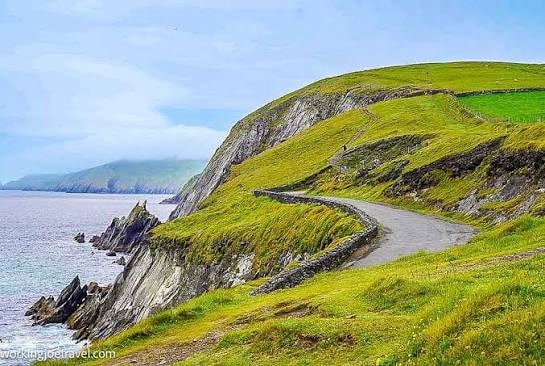
Best Time to Visit
May to September is ideal for a first visit, with the best weather, longest days and all attractions open. September is possibly our favourite — plenty of daylight but fewer peak-season crowds. Autumn is still beautiful and atmospheric. Leave Dingle in the morning to beat tour buses and parking pressure. Late afternoon is also gorgeous around the western viewpoints. Winter is possible but days are short and Atlantic weather can be severe.
Getting There
Slea Head Drive begins and ends in Dingle town, County Kerry. From Dingle town centre, follow the R559 west towards Ventry and continue clockwise around the peninsula. Follow road signs rather than sat-nav — the Dingle Peninsula Tourism Alliance operates a clockwise visitor system and some roads are designated Local Access Only. Dingle is approximately 50km west of Tralee — allow around 50 minutes via the N86. The loop is approximately 47–48km and returns to Dingle, so no backtracking is required.
Highlights
Quick Facts
County
County Kerry
Region
South West
Category
Coastal


Keep exploring