The Burren — Travel Through Ireland

About
The Burren is unlike anywhere else in Ireland — or indeed anywhere else in Europe. A vast limestone plateau covering around 250 square kilometres of north County Clare, it presents a landscape that appears at first glance to be almost entirely bare: grey pavements of karst limestone, cracked and fissured, stretching to the horizon under enormous Atlantic skies. And yet this apparently barren terrain supports one of the richest concentrations of plant life in Ireland, including species from the Arctic, the Alps, and the Mediterranean growing side by side in the same rock crevices.
The botanical paradox of the Burren is explained by the limestone itself. The rock absorbs heat during the day and releases it slowly at night, creating a microclimate that is warmer than the surrounding land in winter and cooler in summer. The deep grykes — the vertical fissures in the limestone pavement — provide shelter from wind and grazing animals, allowing fragile plants to establish themselves. In May and June, the Burren erupts into colour: mountain avens, bloody cranesbill, spring gentian, and dozens of orchid species bloom across the grey rock in a display that draws botanists from across Europe.
The Burren is also one of the most archaeologically rich landscapes in Ireland. The Poulnabrone Dolmen, a portal tomb dating to around 4200 BC, is one of the most iconic prehistoric monuments in the country — a massive capstone balanced on two upright stones, silhouetted against the limestone plateau in a composition that has been photographed millions of times and still manages to be genuinely moving in person. Excavations in the 1980s found the remains of at least 33 individuals buried beneath it. Across the Burren, over 90 megalithic tombs, 500 ring forts, and numerous early Christian churches and holy wells are scattered across the landscape.
Ailwee Cave, near Ballyvaughan, offers a glimpse into the underground world that lies beneath the limestone surface. The cave system extends for nearly a kilometre into the hillside, with stalactites, stalagmites, and a frozen waterfall among the highlights. The bones of brown bears, extinct in Ireland for over 10,000 years, were found in the cave when it was first explored in the 1940s. The Burren also contains the Aillwee Birds of Prey Centre, where daily flying demonstrations feature eagles, hawks, and owls.
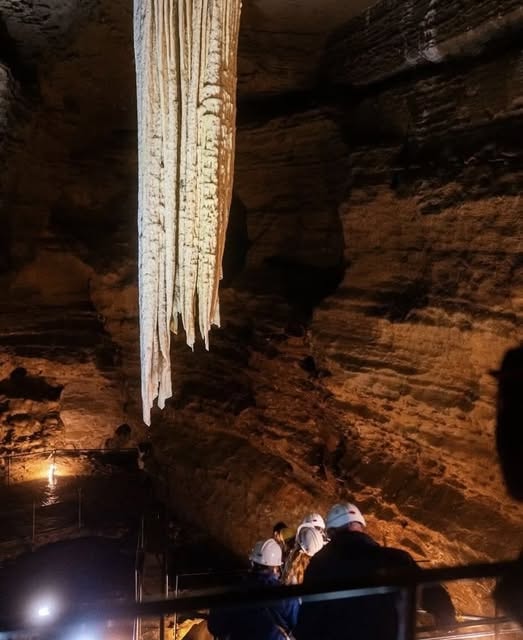
The village of Doolin, on the western edge of the Burren where the limestone meets the sea, is one of the great centres of traditional Irish music. Three pubs — McGann's, McDermott's, and Gus O'Connor's — have been hosting sessions for decades and attract musicians from across Ireland and beyond. Doolin is also the departure point for ferries to the Aran Islands and offers views across to the Cliffs of Moher just a few kilometres to the south. Beneath the limestone plateau, the Burren also hides one of Ireland's most dramatic underground spaces — the Great Stalactite in Doolin Cave is the longest free-hanging stalactite in the Northern Hemisphere, and a guided tour of the cave is one of the most memorable things you can do in Clare. The Burren Way, a 123km walking route, passes through Doolin and traverses the full length of the plateau from Lahinch to Corofin.
Best Time to Visit
May and June are the peak months for wildflowers and the best time to experience the Burren at its most spectacular. The spring gentian — a vivid blue flower that is the symbol of the Burren — blooms from April to June, and the orchids follow through May and into July. The Burren is beautiful year-round, however — autumn brings a different palette of colours, and winter visits to the dolmens and ring forts, with few other visitors around, can be deeply atmospheric. The Burren in Bloom festival takes place in May and includes guided walks, talks, and events celebrating the landscape.
Getting There
The Burren is in north County Clare, roughly 60km from Galway city and 30km from Ennis. By car from Galway, take the N67 through Kinvara and Ballyvaughan — allow about an hour. Bus Éireann runs services from Galway and Ennis to Ballyvaughan and Doolin, but services are infrequent and a car gives much more flexibility to explore the plateau. The Burren is often combined with the Cliffs of Moher on the same day — the two are about 20km apart and together make one of the finest day trips in the west of Ireland. Ennis, the county town of Clare, is the nearest large town with a full range of accommodation.
Insider Tips
Visit Poulnabrone Dolmen at dawn or dusk when the light is low and the crowds are thin — the monument is at its most atmospheric when you have it to yourself, and the early morning light on the limestone is extraordinary.
Pick up a copy of the Burren wildflower guide before you go — the sheer variety of species is bewildering without some help identifying them, and knowing what you're looking at transforms the experience.
Don't miss a traditional music session in Doolin — arrive early to get a seat, order food, and settle in for the evening. The sessions at Gus O'Connor's and McGann's are among the best in Clare. While you're in Doolin, Doolin Cave is just up the road and makes a brilliant morning activity before the evening session — the Great Stalactite is genuinely jaw-dropping.
The Burren Food Trail connects local producers, restaurants, and food experiences across the region — the Burren Smokehouse in Lisdoonvarna and the Burren Perfumery café are both excellent stops.
Walk at least a short section of the limestone pavement away from the road — the experience of standing on the bare rock with wildflowers growing in the cracks around you, and nothing but sky and stone in every direction, is one that stays with you.
Highlights
Quick Facts
County
County Clare
Region
West
Category
Heritage


Keep exploring