
Kilmainham Gaol: Tickets, Tours & Visitor Guide
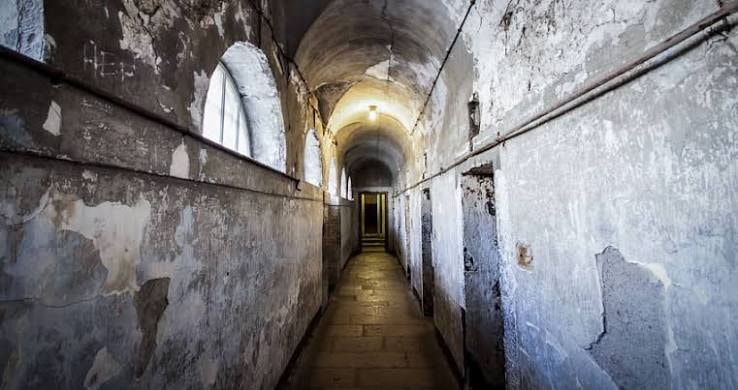
Kilmainham Gaol
One of Dublin's most powerful and important museums — a working Victorian prison that held political prisoners from 1798 to the Civil War, including fourteen leaders executed after the 1916 Easter Rising.
About
Few buildings in Dublin contain as much history as Kilmainham Gaol. Opened in 1796 as the new County Gaol for Dublin, the prison operated for more than 120 years and held everyone from people convicted of minor crimes to some of the most significant figures in Ireland's political and revolutionary history. Leaders connected with the rebellions of 1798, 1803, 1848, 1867 and 1916 were imprisoned here, alongside figures from the War of Independence and Civil War. Fourteen leaders of the 1916 Easter Rising were executed within the prison complex. But Kilmainham's story isn't only about famous political prisoners — thousands of ordinary men, women and children were incarcerated here too, including people imprisoned for offences such as stealing food during the Great Famine. Today it is one of Dublin's most fascinating and most visited museums.
The single most important thing to know before visiting: access to the Gaol itself is by guided tour only, and advance online booking is essential. Kilmainham is extremely popular and tours regularly sell out. Tickets are released 28 days in advance at midnight Irish time. If your preferred date is sold out, don't immediately give up — additional or cancelled tickets are released online from around 9:15am–9:30am on the day of the visit. That's a very useful piece of information to have. The Office of Public Works also warns that no third-party company is authorised to sell Kilmainham Gaol tickets, and there have been fraudulent websites designed to look like the real booking site. Book directly through the official Heritage Ireland system only. Current admission prices are: Adult €8, Senior €6, Student €4, Child aged 12–17 €4, Child under 12 free (but still requires a ticket), Family (2 adults plus 2 or 3 children) €20.
The guided tour lasts approximately one hour, and visitors should allow another 30–45 minutes to explore the museum afterwards — a total visit of around 90 minutes. Visitors are asked to arrive approximately 15 minutes before the scheduled tour time. The Courthouse Visitor Centre is open 9:30am–5:15pm, and the museum operates 10:30am–5:15pm during October–March, generally later from April–September. The museum is closed 24–27 December. Kilmainham is approximately 3.5km from Dublin city centre. There is no visitor car park at the Gaol itself — the museum recommends using the nearby car park at the Irish Museum of Modern Art / Royal Hospital Kilmainham, accessed via Military Road, from where it's approximately a five-minute walk. The Luas Red Line also serves the wider area, with Suir Road as the nearest stop.
The tour covers the full history of the prison rather than treating Kilmainham solely as a 1916 site. Political prisoners associated with Kilmainham include Robert Emmet, Anne Devlin, Charles Stewart Parnell, Constance Markievicz, Patrick Pearse, James Connolly and Joseph Plunkett. The tour's strongest section for many visitors is the Stonebreakers' Yard — a quiet, stark outdoor space where fourteen leaders of the 1916 Easter Rising were executed by firing squad. James Connolly, who had been seriously wounded during the Rising, was executed on 12 May 1916. One of Kilmainham's most poignant stories is that of Joseph Plunkett and Grace Gifford: on the night before his execution, Plunkett married Grace inside the prison chapel by candlelight. He was executed on 3 May 1916. The story has become one of the best-known personal accounts connected with the Gaol.
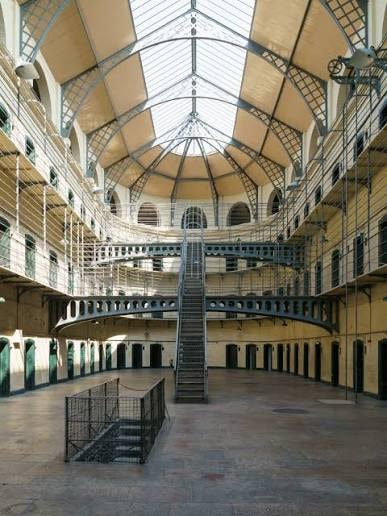
Architecturally, the most recognisable section is the spectacular Victorian East Wing — tall iron galleries rising around a huge central hall beneath a glass roof, designed to reflect Victorian thinking about prison discipline and surveillance. Today it's one of the most photographed interiors in Dublin and has appeared in films including The Italian Job, In the Name of the Father, Michael Collins and The Wind That Shakes the Barley. The prison finally closed in 1924, after which the building fell into serious decline. A voluntary restoration movement began work during the 1960s, and Kilmainham was handed over to State care in 1986, now managed by the Office of Public Works. After the guided tour, the museum covers the prison's history from 1796, ordinary prisoners, political prisoners, the Great Famine, Irish revolutionary history and personal objects associated with former prisoners.
There are currently two particularly interesting temporary exhibitions running. The chalice and altar vessels used during the 1916 wedding of Joseph Plunkett and Grace Gifford are on public display from 23 September until 31 December 2026. A second exhibition — The Prisoners' Lens: Secret Photography in Kilmainham Gaol, 1921 — explores photographs secretly taken inside Kilmainham during the War of Independence and runs until 31 October 2026, with free admission to the exhibition itself. Kilmainham is an old historic prison, so not every section is straightforward for visitors with reduced mobility — the normal guided route includes stairs and uneven surfaces, but the museum can arrange a ground-floor tour for wheelchair users or visitors with mobility issues. The tour is not recommended for children under six, and pushchairs are not permitted on the guided tour. The Irish Museum of Modern Art is a short walk away and makes a brilliant pairing for a full Dublin history day.Phoenix Park is a short distance north and works well as an afternoon addition after a morning at Kilmainham — particularly if the weather is good.
Highlights
Quick Facts
County
County Dublin
Region
Leinster
Category
Heritage


Keep exploring