
Loop Head Lighthouse: Tickets, Tours & Visitor Guide
Loop Head Lighthouse
Standing at the very tip of the Loop Head Peninsula — 350 years of lighthouse history with Atlantic views to match.
About
Standing at the very tip of the Loop Head Peninsula in County Clare, Loop Head Lighthouse feels like it really is sitting at the edge of Ireland. On one side, you've got the relatively sheltered waters of the Shannon Estuary. On the other? The full force of the Atlantic Ocean. Add dramatic cliffs, seabirds, dolphins, an enormous sky and views stretching towards Kerry and Connemara, and you've got one of the most impressive lighthouse locations on the Wild Atlantic Way.
Visitors can explore the Lightkeeper's Cottage, learn about more than 350 years of lighthouse history and take a guided tour up the tower to the balcony. And unlike some famous coastal landmarks, Loop Head still feels wonderfully remote. For us, that's a huge part of its appeal.
Loop Head Lighthouse is located at Kilbaha South, County Clare, V15 T292. It stands at the western tip of the Loop Head Peninsula, beyond the small village of Kilbaha. The location marks the point where the River Shannon meets the Atlantic Ocean. This is not somewhere you accidentally pass on the way to somewhere else. You have to make the journey out here. And that's part of what makes it special.
The lighthouse is fairly remote, so allow more driving time than the distance might suggest. The official visitor information recommends allowing more than 40 minutes from Kilrush, more than 80 minutes from Ennis, and more than 90 minutes from Shannon Airport. The roads become increasingly rural as you travel along the peninsula. Don't rush them — there are plenty of reasons to stop along the way.
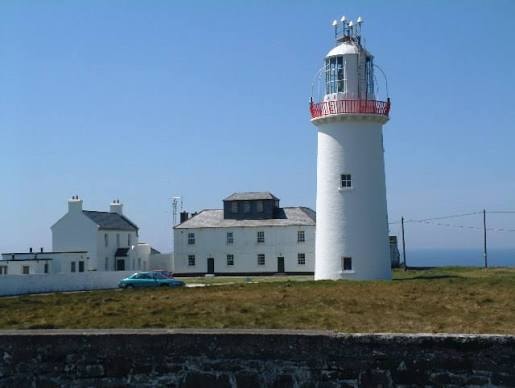
Loop Head has been guiding ships for more than 350 years. The site's lighthouse history stretches back to 1670, when an early cottage-style light operated here with a coal-burning brazier positioned on the roof. Part of that early structure can still be identified today. The first proper lighthouse tower was built in 1802, and the current tower — designed by the famous Irish lighthouse engineer George Halpin — dates from 1854. The lighthouse became automated in 1991 and remains operational under the Commissioners of Irish Lights.
The highlight of a visit is the guided tower tour. You'll learn about the lighthouse's history before climbing inside the tower and stepping onto the outside balcony. Weather permitting, the views are extraordinary — potentially stretching south towards the Blasket Islands and north towards the Twelve Bens of Connemara. The tower itself stands around 23 metres high, but it sits on cliffs rising to around 90 metres above the Atlantic, which is what gives the views their enormous scale.
Current 2026 guided-tour prices start from €8 for adults, €6 for seniors and students, and €5 for children under 18. Access to the lighthouse tower is by guided tour only, with limited numbers — we'd book ahead during summer weekends. General admission (grounds and Lightkeeper's Cottage exhibition) costs €3 for adults and is free for under-18s.
For 2026, the lighthouse operates from 14 March through April on weekends and bank holidays, daily from 2 May through 27 September, and weekends and bank holidays only through 26 October. Opening hours are 10am–5pm, with the first guided tower tour at 10:30am and the final tour at 4:30pm. If you're visiting outside the main summer season, check before you travel.
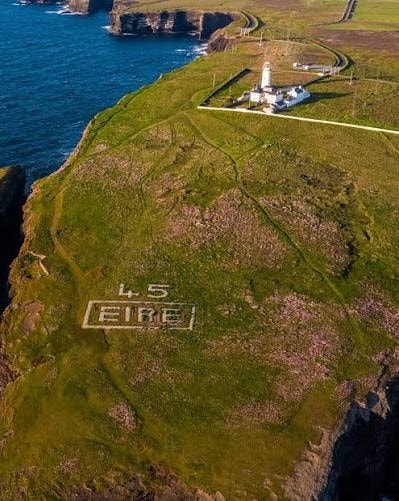
One of the most fascinating features near the lighthouse is a huge ÉIRE sign cut into the landscape. During the Second World War, large signs were positioned along Ireland's coastline to identify the country to aircraft flying overhead. Ireland remained neutral during the war. The Loop Head sign is one of the surviving examples — there were 85 such signs along Ireland's western seaboard. It's a brilliant historical feature that's easy to miss if you don't know it's there.
The waters around Loop Head support an important population of bottlenose dolphins — around 160 live around the mouth of the Shannon Estuary. Whales, seals and seabirds including fulmars and kittiwakes can also be seen from the headland. The lighthouse balcony is an excellent place to keep watch. Bring binoculars if you have them.
Don't immediately jump back into the car after your lighthouse tour. The landscape around Loop Head deserves time. You can walk around the headland taking in cliffs, sea stacks, enormous Atlantic views and wild coastal vegetation. The wider Loop Head Drive weaves between beaches, cliffs, villages, harbours and Atlantic viewpoints. Discover Ireland describes the peninsula as one of Ireland's most remote and beautiful coastal landscapes.
Loop Head has high, exposed cliffs. Much of the attraction is the fact that the landscape remains relatively natural — that means visitors need to behave accordingly. Strong winds are common and the lighthouse's own guidance warns visitors to keep away from cliff edges, particularly with children and dogs. No photo is worth walking dangerously close to an Atlantic cliff.
Here's something slightly different: you can actually stay overnight at Loop Head Lighthouse. The restored Lighthouse Attendant's Cottage sits around 100 metres from the tower and contains three bedrooms, a kitchen, living space and sea views. It was extensively renovated in 2024. If you're looking for unusual accommodation in Clare, this is about as atmospheric as it gets — once the daytime visitors leave, you're basically sitting at the end of a peninsula surrounded by Atlantic Ocean.
Best Time to Visit
Late spring through September gives the easiest access, with the lighthouse open daily from 2 May through 27 September 2026. June and July offer wonderfully long evenings. September can be quieter with excellent light. Autumn weather can make the coastline spectacular. Views from the balcony depend heavily on conditions — a clear day and a wild Atlantic day are both impressive, just in very different ways. Outside the daily season, the lighthouse operates weekends and bank holidays only.
Getting There
Loop Head Lighthouse is located at Kilbaha South, County Clare, V15 T292, at the western tip of the Loop Head Peninsula. Allow more than 40 minutes from Kilrush, more than 80 minutes from Ennis, and more than 90 minutes from Shannon Airport. The roads become increasingly rural as you travel along the peninsula — don't rush them. Free parking is available at the lighthouse. The official visitor information asks guests to arrive around 15 minutes before their booked tour time.
Insider Tips
Don't just drive to the lighthouse and drive straight back. Make Loop Head a full coastal trip. Start around Kilkee, follow the peninsula towards Carrigaholt and Kilbaha, stop at the Bridges of Ross, then continue to Loop Head for a pre-booked tower tour. Give yourself time afterwards to walk around the headland and look for dolphins.
Book your guided tower tour in advance, especially during summer weekends. Numbers are limited and the tour is the highlight of the visit. Arrive around 15 minutes before your tour time as the official visitor information requests.
Keep an eye out for the ÉIRE sign cut into the headland near the lighthouse — it's one of 85 Second World War coastal markers and easy to miss if you don't know it's there. The aerial photo from above the lighthouse shows it clearly.
Stay well back from the cliff edges. The landscape is relatively natural and exposed, with strong Atlantic winds common. The lighthouse's own guidance specifically warns visitors to keep away from cliff edges, particularly with children and dogs.
Highlights
Quick Facts
County
County Clare
Region
West
Category
Heritage


Keep exploring