
Rock of Dunamase: Parking, History & Visitor Guide
Rock of Dunamase
A dramatic medieval castle ruin rising above the Laois countryside — free to visit, steeped in Viking and Norman history, and one of Ireland's most impressive hilltop fortifications.
About
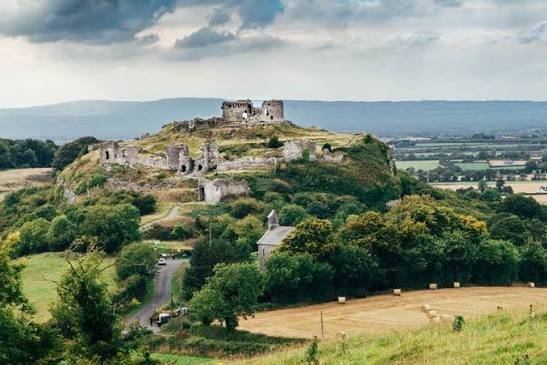
The Rock of Dunamase is located at Dunamase, Aghnahily, County Laois — only a short drive east of Portlaoise. Heritage Ireland describes the castle as sitting on a dramatic limestone outcrop roughly four miles east of the town. That makes it an incredibly easy stop if you're exploring Laois, travelling through the Midlands, or driving between Dublin and destinations farther west. The name comes from the Irish Dún Másc, meaning roughly 'Fort of Másc'. Heritage Ireland says the site was once a stronghold of the ancient Irish kings of Laois — strategically important long before the huge Anglo-Norman stone castle appeared.
The earliest major occupation here predates the surviving castle. Heritage Ireland identifies Dunamase as an early medieval dún, or fortified settlement, with archaeological work revealing surviving traces of those earlier defences. A 9th-century silver penny was discovered during excavations in the 1990s. Dunamase also appears in medieval annals after it was attacked by Vikings in the mid-9th century. The Rock later became tangled up in one of the most famous political marriages in medieval Irish history — in 1170, Aoife, daughter of Diarmaid Mac Murrough, King of Leinster, married the Anglo-Norman leader known as Strongbow, and Heritage Ireland says Dunamase formed part of Aoife's dowry. Aoife and Strongbow's daughter Isabel de Clare later married William Marshal, Earl of Pembroke — one of the most powerful nobles in medieval Europe — and Dunamase again passed as part of a marriage settlement. Under Anglo-Norman control, the site developed into an enormous fortified complex.
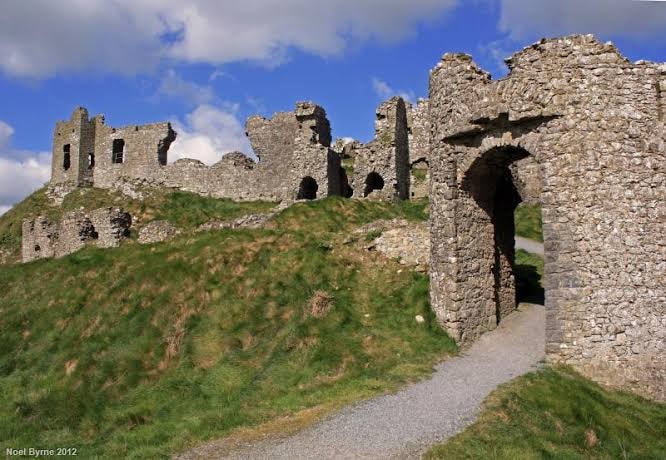
Dunamase was designed in layers. Attackers approaching the summit had to pass through multiple defensive points before reaching the strongest inner area. The surviving ruins include outer defensive walls, a gatehouse, lower ward, inner ward, curtain walls and the remains of the great hall. Heritage Ireland's archaeological work identified major rebuilding of the defences during the early 13th century, including arrow loops, a portcullis slot, cut sandstone around openings and stronger stone walls. The site also had a sallyport — a small fortified side entrance allowing defenders to leave quickly, attack an enemy and retreat again. At the highest point of the Rock are the remains of the medieval hall. From here you can see why Dunamase mattered: the surrounding countryside stretches for miles, and anyone approaching across the plains below would have been visible long before reaching the castle.
Heritage Ireland records a major attack in 1320 when local Gaelic forces attacked Dunamase, after which the castle appears to have declined rapidly. Archaeological evidence suggests it had largely been abandoned by the middle or second half of the 14th century. Dunamase later returned into Gaelic Irish hands — Heritage Ireland says the O'Mores of Laois appear to have taken control of the surrounding lands by the late 14th century. The Rock was reused during the turbulent 1640s, and in 1650 the site suffered major destruction during the Cromwellian invasion. Heritage Ireland notes that some of the destruction may have involved gunpowder and that Cromwellian forces have traditionally been associated with deliberately slighting the castle. Towards the end of the 18th century, politician Sir John Parnell attempted to restore parts of Dunamase for use as a banqueting hall — architectural pieces were brought from other ruined buildings and incorporated into the site, though his son later allowed the attempted restoration to decay again.
Major archaeological investigations took place during the mid-1990s, producing more than 5,500 archaeological objects including arrowheads, weapons, armour fragments, horse equipment, door fittings, copper-alloy pins and medieval coins. Major conservation work followed, with the OPW carrying out a substantial stabilisation programme costing around €1.6 million to conserve the remaining walls, improve visitor access and install interpretation around the site. That's why the ruins today remain extensive enough to explore safely while still feeling wonderfully wild. The Rock of Dunamase forms part of Ireland's Ancient East — with layer after layer of history from early Irish kings and Viking attacks through Anglo-Norman lords, Gaelic resurgence, Confederate wars and Cromwellian destruction.
Admission is free. Access is available during daylight hours — there are no tickets, no booking slots and no visitor-centre entrance fee. Parking is limited, with room for roughly eight cars beside the entrance according to Heritage Ireland's current information. On busy weekends spaces can disappear quickly. Heritage Ireland also specifically warns visitors to take care because the nearby road remains active. Discover Ireland recommends around 1–1½ hours for a visit. The approach is relatively short but once you're among the ruins you'll encounter uneven ground, loose stones, grass, steeper sections and broken medieval masonry — Heritage Ireland specifically recommends appropriate footwear. Trainers with decent grip or walking shoes are ideal. The site is listed as family friendly and dog friendly by Discover Ireland, though younger children need close supervision given the open drops and uneven surfaces. There is no major visitor centre, café or toilet block — for food and broader facilities, nearby Portlaoise is your best option.
Discover Ireland specifically highlights sunrise and sunset as particularly good times for photography, and the low light catches the ruins beautifully. But remember that access is during daylight hours and you've still got uneven ground to negotiate on the way down. For a great Laois heritage route, combine the Rock of Dunamase with Timahoe Round Tower — one of the finest surviving examples in Ireland — and Emo Court, a grand neoclassical house and estate offering gardens, woodland walks and historic architecture. That gives you a seriously underrated day out: wild medieval ruin, elegant country estate and a remarkable round tower, all within easy driving distance of each other.
Best Time to Visit
The Rock of Dunamase is accessible during daylight hours year-round. Spring offers green countryside and manageable walking conditions. Summer brings long daylight and excellent views, though it can be busier. Autumn is arguably the best season — the countryside changes colour, the light is beautiful and Discover Ireland specifically recommends autumn visits. Winter is still accessible but expect mud, wind, cold and potentially slippery ground, making proper footwear considerably more important. Discover Ireland particularly recommends sunrise and sunset for photography — the low light catches the ruined walls beautifully.
Getting There
The Rock of Dunamase is located at Dunamase, Aghnahily, County Laois, roughly four miles east of Portlaoise on the N80. Parking is limited — Heritage Ireland currently lists room for approximately eight cars close to the monument entrance. On busy weekends spaces fill quickly. Heritage Ireland specifically warns that the nearby road is active and not a safe place to stand taking photographs, so park properly before exploring. The site makes an easy stop when travelling between Dublin and destinations in the west of Ireland.
Highlights
Quick Facts
County
County Laois
Region
Midlands
Category
Heritage


Keep exploring