
Ballintubber Abbey Mayo: History, Tours & Visitor Guide
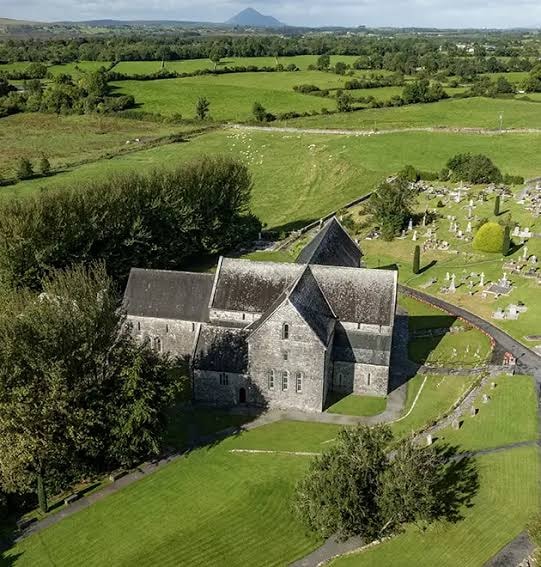
Ballintubber Abbey
Founded in 1216 and still in use today — the abbey that refused to die.
About
Some historic buildings are preserved because people eventually decided they were worth saving. Ballintubber Abbey is different. For more than 800 years, people have continued gathering, praying and celebrating here. Founded in 1216 by Cathal Crovdearg O'Conor, King of Connacht, Ballintubber Abbey has survived fire, invasion, religious suppression, the Penal Laws, the Great Famine and centuries of political upheaval. Parts of the monastery were destroyed. Its roof was burned. At times priests were forced to celebrate Mass secretly. Yet worship at Ballintubber continued. That's why the abbey is sometimes affectionately described as the Abbey that refused to die.
Today Ballintubber is both an important historic site and a working parish church. Visitors can explore the medieval abbey, landscaped grounds, St Patrick's Well, sculptures and surviving monastic remains, or book a guided tour to uncover more than eight centuries of history. And for walkers, Ballintubber marks the beginning of something even bigger. The ancient Tóchar Phádraig pilgrimage route runs for approximately 35km from the abbey towards Croagh Patrick.
Ballintubber Abbey is located in the small village of Ballintubber in County Mayo. The address is Ballintubber, Claremorris, County Mayo, F12 W584. Despite the Claremorris postal address, Ballintubber is particularly convenient for anyone exploring the Castlebar, Westport and Ballinrobe areas. Castlebar is around a 10-minute drive, while Westport, Ballinrobe and Claremorris can all generally be reached within approximately 30 minutes. The abbey sits just off the N84, with local signposting directing visitors towards it. There is free car parking at the abbey.
Ballintubber Abbey was founded in 1216. Its founder was Cathal Crovdearg O'Conor, whose name is sometimes translated as Cathal of the Red Hand. He was King of Connacht and belonged to one of the most powerful Gaelic dynasties in medieval Ireland. Construction continued for several years and the abbey was completed around 1225. It was entrusted to the Canons Regular of St Augustine and developed into an important religious centre. That means Ballintubber was already standing before many of Ireland's famous later medieval castles had even been built.
As with so many ancient Irish places, history and folklore become wonderfully tangled at Ballintubber. According to local tradition, Cathal spent part of his youth in this area while fleeing danger. A local man named Sheridan treated him kindly. Cathal promised that if his fortunes improved, he would never forget Sheridan's generosity. Years later, after becoming king, Cathal returned and asked what he could do for him. Sheridan requested that the old local church be repaired. Cathal agreed to build an entirely new church instead. But according to the story, something went wrong — the king's instructions were misunderstood and a church was constructed at another similarly named location in County Roscommon. When Cathal discovered the mistake, he supposedly promised to build a church at Ballintubber that was seven times more magnificent. And so, legend says, Ballintubber Abbey was born.
Ballintubber's religious history is actually much older than the abbey itself. Tradition connects the site with St Patrick and the year 441 AD. According to local tradition, Patrick established a church in the area and baptised converts at the well now known as St Patrick's Well. That means the abbey built in 1216 was continuing a Christian tradition that people associated with Ballintubber for centuries beforehand. Take time to explore the grounds rather than simply entering the church and leaving — the well remains a sacred place within the Ballintubber landscape and is worth including as part of your walk.
This is one of the biggest differences between Ballintubber and many medieval abbeys around Ireland. It still has a roof. It still has pews. It still has an altar. And Mass is still celebrated here. Walk inside and you'll find substantial medieval stone architecture surrounding an active modern church. Large stone arches frame the interior while narrow windows and whitewashed sections create a surprisingly bright space. You're not walking around the abandoned shell of a monastery. You're entering a building that remains part of the local community more than eight centuries after it was founded.
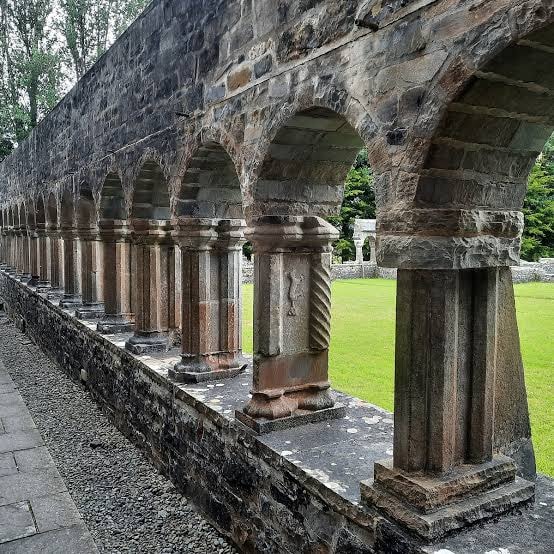
Ballintubber's survival becomes even more remarkable when you look at what happened to it. In 1265, the nave was burned during Norman conflict before being rebuilt around 1270. Later came the Reformation and suppression of monasteries. Land and funding associated with the abbey were confiscated. Then, in 1653, Cromwellian forces attacked Ballintubber. The monastic buildings, domestic quarters and much of the cloister were destroyed. The church's timber roof was burned. But sections of stone vaulting survived. And remarkably, worship continued. Despite destruction and religious persecution, Catholic worship continued at the site through the Penal era. It's one thing for a medieval building to survive physically. It's something else entirely for its original purpose to survive with it.
The abbey also contains a darker reminder of the Penal era. Seán na Sagart became notorious locally as a priest hunter. Priest hunters could receive rewards for locating or capturing Catholic clergy who continued ministering despite the Penal Laws. Tradition records that Seán na Sagart died in 1726 while pursuing a priest named Fr David Burke in the Partry area. He was buried in the grounds of Ballintubber Abbey. According to local tradition, a tree later grew through his grave and split it. The grave and tree remain part of the history visitors can discover at Ballintubber today.
Ballintubber also has a fascinating connection with one of Mayo's most famous historical figures — Grace O'Malley, Gráinne Mhaol, the legendary Pirate Queen. Her son Tiobóid na Long, or Theobald Bourke, is associated with Ballintubber Abbey and is buried here. His nickname translates roughly as Tibbot of the Ships. According to tradition, Tiobóid was born aboard one of his mother's ships in 1567. His father was Richard Bourke, known as Richard-in-Iron. Tiobóid later became an important political figure and was created Viscount Mayo. For visitors exploring Mayo, that connection immediately links Ballintubber with the extraordinary wider story of Grace O'Malley.
Don't treat Ballintubber as a quick ten-minute church visit. The surrounding grounds contain a number of features worth exploring. You'll find landscaped gardens, religious sculptures, the Rosary Way, Calvary, St Patrick's Well and other historic remains connected with the monastery. There's also an Underground Crib and several spaces designed for reflection and pilgrimage. We'd allow enough time to wander rather than rushing straight back to the car. Ballintubber can also work surprisingly well with children. Discover Ireland recommends collecting a map at the visitor centre and following the clues around the grounds — the family activity takes visitors in search of places including the crypt tombs, waterfall and Elizabeth's House.
If you're genuinely interested in the history, we'd recommend taking a guided tour. The tours cover the abbey, crypt, grounds, architecture and many of the stories connected with more than 800 years of history. Current 2026 tour prices are: Adult €12.50, OAP €10.50, Student €10.50, Child aged 12+ €10.50, Child under 11 free. Pre-booking is recommended because tours are subject to availability. The abbey currently lists its scheduled tours as Monday–Thursday at 12pm and 2pm, Friday and Saturday at 3:30pm, and Sunday at 12 noon. Tour arrangements can change because Ballintubber remains a working church and hosts religious services, weddings and events.
The abbey grounds are currently open daily from 9am until 9pm. The Visitor Centre and Gift Shop currently operate Monday–Saturday 9:30am–4:30pm and Sunday 11:45am–3pm. Because the abbey is an active place of worship, access may occasionally be affected by services or events. Current regular Mass times are Sunday at 11am, Tuesday at 7:30pm and Friday at 7:30pm. Visitors should obviously be respectful if arriving during worship.
For walkers, Ballintubber's most fascinating connection may be Tóchar Phádraig — St Patrick's Pilgrim Path. The ancient route travels approximately 35km from Ballintubber Abbey towards Croagh Patrick. Long before it became a Christian pilgrimage trail, the route is believed to have followed an ancient chariot road connecting important places in Connacht. The full route is a serious 35km walk, graded as strenuous, with Ballintubber Abbey advising around 8–10 hours. The route crosses forest tracks, fields, country roads, boggy terrain and mountain paths. Parts of Tóchar Phádraig cross privately owned land, and walkers must register through Ballintubber Abbey. A minimum of two people is required for independent walkers, and dogs are strictly prohibited because of livestock.
You can visit and explore the abbey and grounds without needing to purchase a guided-tour ticket. This makes Ballintubber an excellent stop even if you're travelling around Mayo on a budget. But if it's your first visit, we'd consider paying for the tour — there are so many stories attached to the building that having someone explain what you're looking at adds considerably to the experience. Ballintubber also has a Visitor Centre and Gift Shop beside the abbey, stocking locally produced gifts, crafts and books.
Ballintubber is also a particularly popular wedding venue. Discover Ireland highlights names including Pierce Brosnan, Jean Butler of Riverdance and Shane Filan of Westlife among people who have celebrated weddings here. It's not difficult to see the appeal — a medieval abbey that's still an active church creates a setting very few modern venues could imitate.
One of the easiest places to combine with Ballintubber is Moore Hall. The ruined Georgian mansion sits hidden within woodland overlooking Lough Carra. Moore Hall gives you an easy forest walk and an extraordinary story involving the Moore family, the 1798 Rebellion, Irish literature and the Civil War. The two sites complement each other beautifully — at Ballintubber you've got a medieval religious building still alive after 800 years, while at Moore Hall you've got a grand mansion abandoned after being burned in 1923. They're close enough to visit on the same trip and together give you two completely different chapters of Mayo history.
Insider Tips
Take the guided tour if you can. Ballintubber is one of those places where the stories completely change the experience. Without them, you're looking at an impressive medieval church. Once you know about Cathal Crovdearg, the accidental church in Roscommon, Cromwellian destruction, Grace O'Malley's family, priest hunters and the pilgrims walking towards Croagh Patrick, every corner starts to mean something.
Spend time exploring the grounds before leaving. The abbey itself is only part of what's here — St Patrick's Well, the Rosary Way, the Seán na Sagart grave and the landscaped gardens all reward a slower visit.
If you're planning a wider Mayo day, combine Ballintubber with Moore Hall. The two are close enough to work perfectly together and give you completely different experiences — a medieval abbey still alive after 800 years alongside a grand mansion abandoned after being burned in 1923.
Comfortable shoes are perfectly adequate for exploring the church and grounds. A waterproof jacket is always useful — this is County Mayo. If you're doing Tóchar Phádraig, however, that's completely different. Proper walking footwear, waterproofs, food, water and preparation are essential for the full pilgrimage route.
Discover Ireland recommends 1–2 hours for a visit. If you're simply looking around independently, an hour should give you plenty of time. For a guided tour followed by exploring the grounds, allow closer to two hours. Obviously, if you're setting off along the full Tóchar Phádraig, you're in for a full day.
Highlights
Quick Facts
County
County Mayo
Region
West
Category
Heritage


Keep exploring