Hill of Tara: History, Walk, Parking & Visitor Guide
Hill of Tara
The ancient seat of the High Kings of Ireland — 5,000 years of history, mythology and the legendary Lia Fáil on a single Meath hilltop.
About
Few places in Ireland carry the same weight of history and legend as the Hill of Tara in County Meath. At first glance, it can look surprisingly simple — rolling green fields, ancient earthworks, a standing stone, and huge views across the surrounding countryside. But this hill was once one of the most important ceremonial and political landscapes in Ireland. For centuries, Tara was associated with the High Kings of Ireland. Long before that, people were building monuments here during the Stone Age, and the oldest surviving structure on the hill dates back around 5,000 years. Later generations connected Tara with Irish mythology, the Tuatha Dé Danann, legendary kings and the arrival of Christianity.
Today the palaces and great halls are gone. What remains are grassy ridges, circular enclosures, burial monuments and one of Ireland's most famous stones — the Lia Fáil, or Stone of Destiny. The Hill of Tara is free to explore throughout the year, while guided tours and the visitor centre operate during the main season from 1 May to 30 September. And because the main walking route is only around 1.3 kilometres, this is one of the easiest major ancient sites in Ireland to add to a day exploring County Meath.
Tara's significance developed over thousands of years. Heritage Ireland traces its importance back to the late Stone Age, when a passage tomb was constructed here. The site became especially significant during the Iron Age and Early Christian period, when it became associated with the kingship of Ireland. Tara wasn't necessarily a permanent royal capital in the modern sense — its importance was largely ceremonial, political and symbolic. This was where kingship was legitimised, where rulers were associated with the sacred landscape, and where Irish mythology placed some of its most important events. Even after Tara's political power faded, its symbolic importance survived.
Perhaps the most famous object on the Hill of Tara is the Lia Fáil — the Stone of Destiny. It stands on the monument known as An Forradh. According to Irish mythology, the Lia Fáil was one of the legendary treasures brought to Ireland by the Tuatha Dé Danann. Tradition says the stone would roar when touched by the rightful king of Ireland. Today, the tall standing stone is one of the most photographed features at Tara and offers superb views across the surrounding countryside.
One of the most important monuments on the hill is considerably older than the stories of High Kings. The Mound of the Hostages is a passage tomb dating back approximately 5,000 years — broadly contemporary with some of Ireland's other great Neolithic monuments, including those at Brú na Bóinne. It looks relatively small compared with Newgrange, but its age is extraordinary. People were burying their dead and conducting rituals on this hill thousands of years before Tara became associated with kingship. Generation after generation kept returning here.
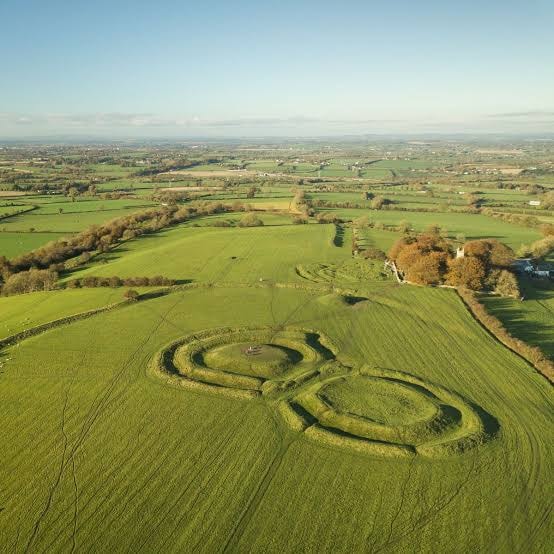
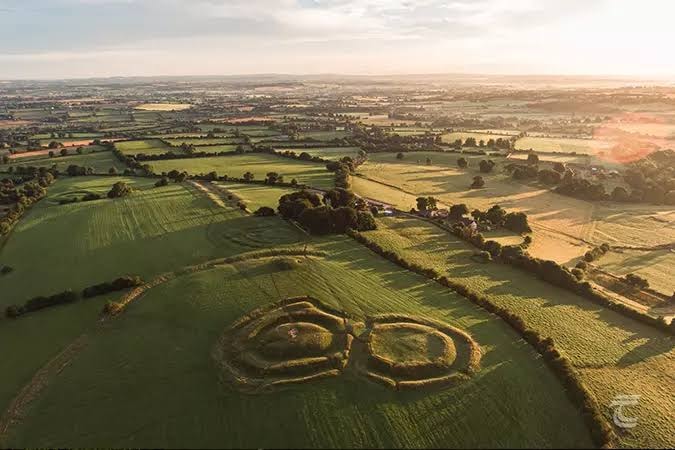
The largest and most significant enclosure on the Hill of Tara is Ráith na Rí — the Fort of the Kings. Heritage Ireland dates its construction to around 100 BC and gives it a circumference of approximately 1,000 metres. Inside the enormous circular enclosure are several other monuments, including An Forradh and Teach Cormaic — Cormac's House. From ground level, some of these earthworks can be difficult to fully understand. From above, the patterns carved into the landscape become much clearer — which is why looking at an aerial image before or after visiting is useful.
One of the legendary figures most strongly associated with Tara is Cormac Mac Airt — in Irish tradition, one of the greatest High Kings. His name will be familiar to anyone who has visited the Caves of Keash in County Sligo, where legend says Cormac was carried into the caves by a she-wolf as a baby before eventually growing up to become High King. That connection — Caves of Keash to Cormac Mac Airt to the Hill of Tara — is exactly the kind of thread that makes exploring ancient Ireland so compelling.
The Hill of Tara also became woven into the story of St Patrick. According to Christian tradition, Patrick came to Tara during the fifth century as Christianity began challenging older Irish religious beliefs. One famous story connects Tara with the nearby Hill of Slane — tradition says Patrick defied the High King by lighting his own Paschal fire at Slane before the great fire at Tara. Whether the story happened exactly that way is impossible to know, but it became one of the great legends surrounding the arrival of Christianity in Ireland. And from Tara, you can actually look towards the Hill of Slane.
Tara's importance didn't end with ancient kings. In 1843, Daniel O'Connell chose the Hill of Tara for one of his enormous political gatherings calling for repeal of the Act of Union — an event Discover Ireland describes as attracting more than one million people. O'Connell understood the symbolism. Standing at the ancient seat of Irish kingship while arguing for greater Irish political independence sent a very deliberate message. Thousands of years after its first monuments were built, Tara was still being used as a symbol of Ireland.
The Hill of Tara is free to explore throughout the year. During the main visitor season (1 May–30 September, 10am–5pm daily), guided tours are available — adult €5, senior €4, student/child €3, family €13. The visitor centre is housed inside the former St Patrick's Church and includes an audio-visual presentation and stained glass by Irish artist Evie Hone. We'd strongly recommend the guided tour if it's available — without context, many of the monuments simply look like humps and ridges in a field. A guide can explain what those earthworks represent and help you picture an ancient ceremonial complex instead. Tara is only 45 minutes from Dublin city, making it an easy day trip from the capital; if you're staying in Dublin, The Long Hall on South Great George's Street is one of the finest Victorian pubs in Ireland and a perfect spot for a pint after a day in the Boyne Valley.
Best Time to Visit
The Hill of Tara works year-round. If you want the visitor centre and guided tour, visit between May and September (daily 10am–5pm). For the landscape itself, spring and autumn can be particularly beautiful. Summer gives you long daylight hours but larger crowds. Early morning is ideal — fewer people, soft light, and a much greater sense of space. The hill feels completely different when it's quiet. After rain, the ground can get muddy, so waterproof footwear is recommended regardless of season.
Getting There
The Hill of Tara is located near Dunsany in County Meath, approximately 12 kilometres south of Navan. The official address is Hill of Tara, Dunsany, Navan, County Meath, C15 P44W. It's easily reached from Dublin and works brilliantly as part of a wider Boyne Valley trip. There is parking close to the entrance to the site — the main visitor facilities including toilets are located around the car park rather than out on the hill itself. During busy weekends and summer days, arriving earlier is advisable. Trim Castle is around 12 kilometres away, and the Brú na Bóinne Visitor Centre for Newgrange and Knowth is approximately 17 kilometres away.
Insider Tips
Do the guided tour if it's available. At a castle, you can usually understand what you're seeing without much help. Tara is different — without context, many of the monuments simply look like humps and ridges in a field. A guide can explain what those earthworks represent and help you picture an ancient ceremonial complex instead.
Allow at least 60–90 minutes even though the walk is only 1.3km. The actual walking doesn't take long — understanding what you're looking at is what makes Tara interesting. If you're taking a guided tour and visiting the visitor centre, allow 1½–2 hours.
Combine Tara with Trim Castle for a brilliant day in County Meath. They're only 12km apart, completely different in character, and together give you an enormous slice of Irish history — from ancient ceremonial kingship to the arrival of the Anglo-Normans.
Look up an aerial image of the site before or after your visit. From ground level, the scale and pattern of the earthworks can be hard to read. From above, the circular enclosures and the relationship between the monuments becomes immediately clear — it transforms how you understand what you've seen.
If Tara sparks an interest in Neolithic Ireland, the Brú na Bóinne Visitor Centre for Newgrange and Knowth is only around 17km away. And if you're drawn to the mythology of the High Kings, the Caves of Keash in County Sligo are connected to the same legendary figure — Cormac Mac Airt — making them a fascinating companion destination on a wider ancient Ireland itinerary.
Highlights
Quick Facts
County
County Meath
Region
East
Category
Heritage


Keep exploring