
Hill of Uisneach: Tours, History, Tickets & Visitor Guide
Hill of Uisneach
The sacred centre of Ireland — 5,000 years of mythology, High Kings and the great Bealtaine fire on a single Westmeath hilltop.
About
In the rolling countryside of County Westmeath stands a hill that, for thousands of years, was regarded as the sacred centre of Ireland. The Hill of Uisneach may rise to only around 180 metres above sea level, but its importance in Irish history and mythology is enormous. Ancient kings gathered here. Great assemblies took place here. The beginning of summer was traditionally celebrated with the lighting of the Bealtaine fire. Irish mythology connects Uisneach with gods and goddesses including Lugh and Ériu, while the enormous Stone of Divisions was traditionally associated with the meeting point of Ireland's ancient provinces. Archaeological remains across the hill span roughly 5,000 years, from the Neolithic and Bronze Age through the medieval period.
Today, Uisneach is still very different from a conventional tourist attraction. There is no open-access trail where you simply arrive and wander around independently. The hill is private land and part of a working farm, meaning visitors must book a guided tour or arrange a private visit in advance. And we'd argue that's actually one of its strengths. Rather than looking at a collection of grassy mounds and wondering what you're seeing, you walk the ancient landscape with a guide who brings its kings, mythology, archaeology and stories back to life.
The roots of Uisneach stretch back beyond written history. Archaeological remains range from the Neolithic period through the Bronze Age and into medieval Ireland. For ancient communities, this wasn't simply a hill with a good view — it became a ceremonial gathering place. Later Irish tradition described Uisneach as the point where Ireland's ancient provinces came together. The surrounding territory became known as Mide, meaning the middle. That name eventually gave us the modern county names Meath and Westmeath. So even the names on today's map preserve something of Uisneach's ancient role. Ancient tradition also referred to a fifth province — Mide — and Uisneach was regarded as the place at the centre where the divisions of Ireland came together.
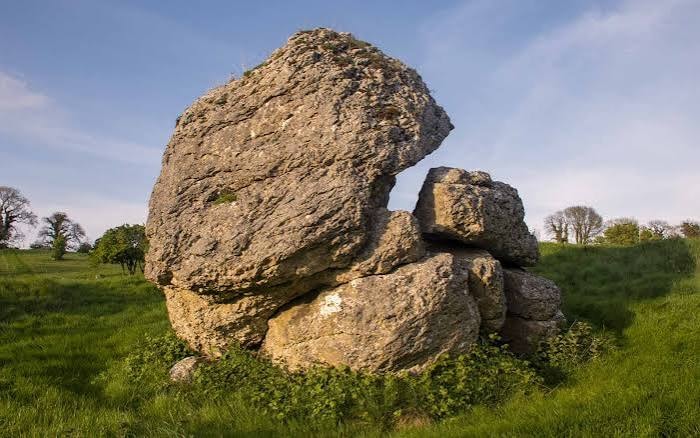
One of the great highlights of the tour is Aill na Míreann — generally translated as the Stone of Divisions, and sometimes called the Cat Stone because of its unusual shape. This is no little standing stone. The huge limestone boulder rises to almost six metres and is estimated to weigh more than 30 tonnes. Geologically, it's a glacial erratic deposited here during the last Ice Age. Mythologically, it's something much more important. The stone was traditionally regarded as marking the centre of Ireland and the meeting point of the provinces. Uisneach is also closely associated with Ériu, one of the great sovereignty goddesses of Irish mythology — and her name is particularly important. Éire, the Irish-language name for Ireland, derives from Ériu. According to tradition, Ériu is buried beneath the Stone of Divisions.
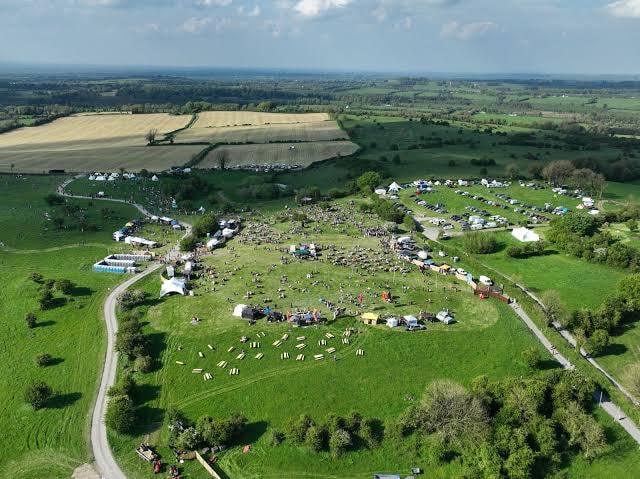
Perhaps the most famous tradition associated with Uisneach is Bealtaine — the beginning of summer in the traditional Irish calendar. According to ancient tradition, a great fire was lit on Uisneach at this time. Fires elsewhere around Ireland were extinguished before being relit from the sacred flame. The Bealtaine Fire Celebration was revived at Uisneach in 2009, and today people once again gather on the hill around the beginning of May for music, storytelling, performance and the lighting of the great fire. One particularly important moment came in 2017, when President Michael D. Higgins lit the ceremonial fire — described by Uisneach as the first Irish Head of State in more than a thousand years to do so. Thousands of years after people first gathered here, Uisneach remains a place of gathering.
Uisneach was also closely connected with kingship. Before Tara became the great political symbol of the High Kings, Uisneach was associated with royal ceremonies and assemblies. Later, when the Hill of Tara became more strongly associated with the High Kings, Uisneach retained its importance as a spiritual and ceremonial centre. The two sites were even linked in tradition by an ancient ceremonial road — Tara was increasingly associated with political kingship, while Uisneach remained the sacred centre. During the first millennium AD, Uisneach became an important royal centre of the Kingdom of Mide, and in 999 Brian Boru came to Uisneach while asserting his power over Mide as part of his wider struggle for supremacy in Ireland.
Uisneach's symbolic importance continued into modern Irish history. During the 19th century, Daniel O'Connell addressed political gatherings here — choosing Uisneach wasn't accidental. O'Connell understood the power of ancient Irish landscapes as symbols, and speaking beside the Stone of Divisions connected contemporary political campaigns with an older idea of Ireland. Padraig Pearse also addressed crowds at Uisneach, as did Éamon de Valera. The same landscape once associated with ancient kings, gods and ceremonial gatherings became a platform for modern Irish political movements. James Joyce was also reportedly captivated by Uisneach's myths and stories, visiting on several occasions and later referring to the Stone of Divisions in Finnegans Wake.
Uisneach reaches approximately 180 metres above sea level — hardly a mountain, but its central position creates extraordinary views. On a clear day, visitor information says you can see parts of up to 20 counties on the horizon. The height itself isn't remarkable. The position is. From the summit, Ireland's central plain seems to spread endlessly around you. Standing there makes the ancient idea of Uisneach as the country's centre feel considerably easier to understand. The Hill of Uisneach forms part of The Royal Sites of Ireland, a group of major ancient ceremonial landscapes placed on Ireland's UNESCO World Heritage Tentative List — alongside Tara, Rathcroghan, Cashel and Dún Ailinne. Its inclusion demonstrates just how significant the landscape is considered archaeologically and culturally.
Best Time to Visit
Public tours run Saturday and Sunday at 11am year-round, with Friday Sunset Tours at 6pm from May to September. If you can time your visit for a Friday evening between May and September, the Sunset Tour is highly recommended — Uisneach already has enormous views, and evening light across Ireland's central plain makes the landscape spectacular. Uisneach also marks the traditional Celtic seasonal festivals — Imbolc, Bealtaine, Lughnasadh and Samhain — with special events that combine storytelling, music and heritage. The Bealtaine Fire Festival around the beginning of May is the most famous. Book well in advance for seasonal events.
Getting There
The Hill of Uisneach is located at Rathnew, Loughnavalley, County Westmeath, N91 R6C9. It sits in the heart of the Irish Midlands, roughly between Mullingar, Athlone and Moate. Free visitor parking is available at the Visitor Centre at the foot of the hill. Because tours leave at set times, arrive around 15 minutes early. The Visitor Centre is housed in a restored traditional Irish cottage — tours begin here, and tea and coffee are served after tours. Mullingar is the nearest large town, approximately 15km away.
Insider Tips
Book before you travel — this is the one thing you really don't want to get wrong. Unlike the Hill of Tara, you cannot simply arrive at Uisneach and start exploring. The hill is private property and a working farm, and access is only through an organised tour or pre-arranged visit. All public-tour places must be booked before arriving.
Current public tours run Saturday and Sunday at 11am year-round, with Friday Sunset Tours at 6pm from May to September. Private tours and group visits can also be arranged. Adult €15, Student/Senior €12, Under 12 free, Family (2 adults + 2 children) €25. The tour lasts around two hours and covers approximately 3km of natural farm and hill terrain — wear waterproof footwear and bring a jacket. The recommended minimum age is around seven.
Dogs are not permitted on the Hill of Uisneach — you're walking through a working farm with livestock. Visitors with specific accessibility requirements should contact the site directly before travelling, as the public tour involves uneven outdoor terrain. Anyone travelling with very young children or buggies should also contact Uisneach in advance to discuss what is practical.
If ancient Ireland is your thing, combine Uisneach with the Hill of Tara on a wider trip through the Midlands and Meath. One gives you the sacred centre. The other gives you the legendary seat of the High Kings. Together, they tell a much bigger story about ancient Ireland.
Highlights
Quick Facts
County
County Westmeath
Region
Midlands
Category
Heritage


Keep exploring