
Carrowkeel Passage Tombs: Walk, Parking & Visitor Guide
Carrowkeel Passage Tombs
Neolithic passage tombs older than the Egyptian pyramids, high in the Bricklieve Mountains with sweeping views across Lough Arrow.
About
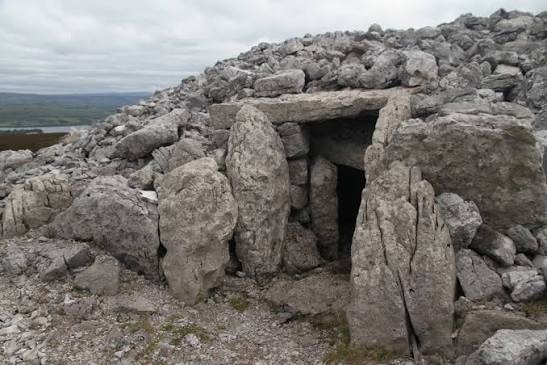
High in the Bricklieve Mountains of County Sligo sits one of Ireland's most extraordinary ancient landscapes. And compared with some of the country's better-known prehistoric sites, remarkably few people seem to know it's here. Carrowkeel Passage Tomb Cemetery — also known as the Carrowkeel Megalithic Cemetery — is a collection of Neolithic passage tombs constructed more than 5,000 years ago. Fourteen ancient cairns are scattered across the hills, with another group of monuments extending west towards Keshcorran Mountain.
There are no enormous visitor centres up here. No cafés. No tour buses lining the road. Instead, you park beside a quiet country road and walk into the mountains. Eventually the ancient stone cairns begin appearing across the landscape. And then you get the views — Lough Arrow lies below, mountains stretch across the horizon, and the countryside of Sligo and neighbouring counties spreads out around you.
Carrowkeel is a Neolithic passage tomb cemetery. The main complex contains 14 cairns positioned across the hilltops, with another group of six cairns extending west towards Keshcorran Mountain. Discover Ireland dates the Carrowkeel tombs to approximately 3200–2400 BC. A passage tomb is a type of prehistoric burial monument — a narrow stone passage leads towards an internal chamber, and the entire structure is covered by a mound or cairn of stone. The tombs were being constructed from roughly 3200 BC, several centuries before the Great Pyramid of Giza was built. These monuments belong to an Ireland that existed thousands of years before castles, Vikings or Christianity arrived here.
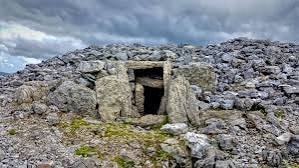
The cairns vary considerably in size and condition. Among the best known are Cairn G and Cairn K, several of which contain surviving passage chambers. Some remain immediately recognisable as substantial prehistoric monuments; others are less obvious. What you're seeing isn't a reconstruction created for tourists — these are genuine archaeological monuments that have survived for thousands of years. Around 140 circular stone foundations have also been identified nearby, thought to represent the remains of a prehistoric settlement. The Bricklieve Mountains were clearly an important place for Neolithic communities — not simply somewhere to dispose of the dead, but part of a much larger ritual and ceremonial landscape.
Carrowkeel has a fascinating — and somewhat troubling — archaeological history. In 1911, R.A.S. Macalister investigated the main group of cairns alongside Robert Lloyd Praeger and E.C.R. Armstrong. The work was carried out extremely quickly — by modern archaeological standards, far too quickly. Macalister removed and disturbed material within the chambers, and those methods have made later investigation more difficult. Praeger later described entering one of the sealed monuments in his book The Way That I Went — imagine being among the first people in thousands of years to enter a chamber built by Neolithic communities. Today, however, visitors have a very different responsibility: these monuments need protecting.
This is extremely important: do not climb on the cairns. Don't move stones. Don't build little stone piles. Don't remove anything. And don't interfere with the chambers. Carrowkeel's passage tombs are protected archaeological monuments. A stone that looks insignificant could form part of a structure that has survived for five millennia. Discover Ireland specifically asks visitors not to climb on or damage the tombs. Leave everything exactly as you find it.
The current Carrowkeel walking route is approximately 5.5 kilometres, graded moderate with around 120 metres of ascent. Sligo Walks suggests allowing around 1½ hours — we'd allow closer to two hours on a first visit. The trail is waymarked with yellow arrows. From the parking area, follow the road and then the signposted gravel track into the mountains. After a couple of kilometres, the route turns towards the area containing the main group of passage tombs. Conditions can change quickly on the exposed Bricklieve Mountains — walking boots are recommended, and bring water.
Carrowkeel sits in the same part of Sligo as the Caves of Keash on Keshcorran Mountain — two of Sligo's most fascinating ancient landscapes remarkably close together. At Keash you've got limestone caves connected with archaeology and Irish mythology; at Carrowkeel you've got Neolithic passage tombs built more than five thousand years ago. Combining both gives you one of the most interesting days of walking and ancient history you can have in County Sligo.
Carrowkeel is completely free to visit. There's no admission charge, no ticket office, and no paid visitor centre at the trailhead. That's one of the reasons it's such a special experience — but free access comes with responsibility. This is a protected archaeological landscape. Treat it with the same respect you'd give to a museum exhibit, except here the exhibit happens to cover an entire mountain.
Best Time to Visit
A dry, clear day is ideal — not only will conditions underfoot be better, but you'll get much more from the huge views across Lough Arrow and the surrounding landscape. Spring through early autumn gives you longer daylight hours, and early morning can be particularly peaceful. Avoid setting off late in the day unless you're confident you'll be back before darkness — there is no lighting on a Neolithic mountain trail. If there has been heavy rain, sections of the trail may be wet or slippery. Check the forecast before leaving, and don't assume that because it's sunny in Sligo Town it'll be equally pleasant on the Bricklieve Mountains.
Getting There
Carrowkeel is located in the Bricklieve Mountains near Castlebaldwin in south County Sligo, approximately 26 kilometres south of Sligo Town and within easy reach of Boyle in County Roscommon. From Sligo, take the N4 towards Dublin for approximately 26.5 kilometres, then leave the main road for Castlebaldwin. Once in the village, turn left and continue along the local roads towards the Bricklieve Mountains. You'll reach a gate across the road where a small amount of roadside parking is available — pass through the gate (close it behind you) and continue to additional roadside parking near the end of the road. The road becomes increasingly narrow as you approach the mountains; drive carefully. There is no large visitor car park — parking is limited and informal. Don't block gates or obstruct the road.
Insider Tips
Allow around two hours rather than the 1½ hours suggested by the official route. You're not coming all this way simply to walk up, look at your watch and immediately walk back down — you'll want to explore, take photographs, and spend time actually appreciating the tombs.
Do not climb on the cairns. This cannot be overstated. A stone that looks insignificant to you could form part of a structure that has survived for five thousand years. Leave everything exactly as you find it and follow any current signage at the site.
Combine Carrowkeel with the Caves of Keash for a brilliant full day in this part of Sligo — but don't underestimate how much walking that gives you. Start with Carrowkeel while you're fresh, then head towards Keash. Together, the two sites tell an extraordinary story of ancient Sligo.
There are no facilities at the tombs — no café, no toilets, no shelter. Use facilities and pick up supplies before heading into the mountains. Castlebaldwin is the closest village; Boyle and Ballymote also provide options depending on your direction of travel.
If Carrowkeel sparks an interest in prehistoric Sligo, your next stop should be Carrowmore Megalithic Cemetery — one of Ireland's most important megalithic landscapes with more than 30 identified tombs and a visitor centre to help explain what you're seeing. And if you're heading south towards Roscommon, Lough Key Forest Park near Boyle makes an excellent addition to the day, particularly if you're travelling with children.
If you're spending time in Sligo town, Thomas Connolly's pub on Markievicz Road is one of the finest traditional pubs in the northwest — a proper Victorian bar with great atmosphere and regular traditional music sessions.
Highlights
Quick Facts
County
County Sligo
Region
West
Category
Heritage


Keep exploring